Test or procedure
Endoscopic ultrasound
Endoscopic ultrasound (EUS) combines an endoscope with a small ultrasound probe, so the doctor can image organs from right next to them, inside the gut. It gives very clear pictures of the pancreas, bile ducts and the wall of the gut, and can take a needle sample if needed.
What it is
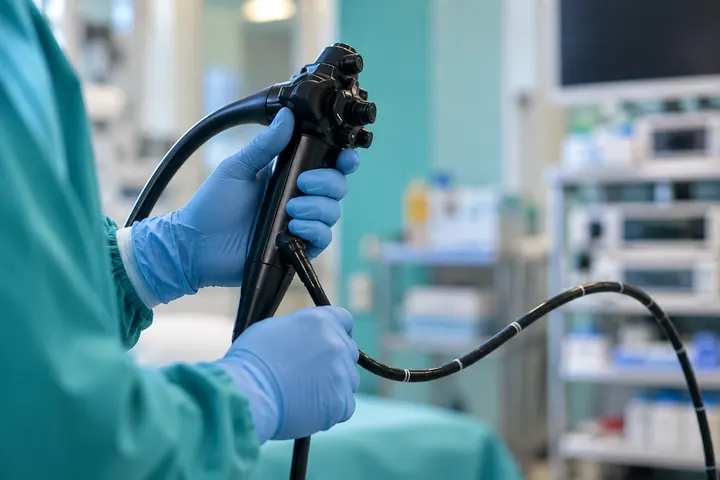
A regular ultrasound scans through the skin, so gas and body fat can blur the picture. In EUS, the ultrasound probe sits at the tip of an endoscope passed through the mouth into the stomach and duodenum, which lie right next to the pancreas and bile ducts. This gives detailed pictures of small stones, cysts, lumps and swollen glands. If something needs testing, a very fine needle can be passed through the scope to take a sample (EUS-guided biopsy or FNA), with no cut on the skin.
Why it is done
- Checking a lump or cyst in the pancreas seen on a scan
- Looking for small bile duct stones when other scans are unclear
- Finding the cause of pancreatitis or long-standing upper tummy pain
- Taking a needle sample from a lump in or near the gut
- Checking how deep a growth in the food pipe, stomach or rectum has spread, to plan treatment
- Examining a bump under the lining of the stomach or food pipe
Before: how to prepare
- Nothing to eat for 6–8 hours before the test. We will tell you until when you can take small sips of water.
- Tell us in advance if you take blood thinners, aspirin or diabetes medicines, especially if a biopsy is planned. Do not stop any medicine on your own.
- You may need blood tests beforehand, including clotting tests if a biopsy is likely.
- Bring all your scan reports and CDs (ultrasound, CT, MRI) and a list of your medicines.
- Come with an adult who can take you home, because you will have sedation.
- Wear loose, comfortable clothes and leave jewellery at home.
On the day
Check-in
The team reviews your scans, medicines and consent form, and a small needle is placed in a vein.
Sedation
You lie on your left side and receive sedation. Your breathing, pulse and oxygen are monitored.
The scan
The scope is passed through the mouth into the stomach and duodenum, and the ultrasound probe images the nearby organs.
Needle sample, if needed
If a lump or cyst needs testing, a fine needle is passed through the scope to take a sample. You do not feel this.
Recovery
You rest for about an hour until the sedation wears off, and the doctor explains the findings.
After
- A sore throat and bloating are common and settle within a day.
- You can usually start with liquids once you are fully awake, then light food, unless told otherwise.
- Do not drive, ride a two-wheeler, operate machinery or sign important documents for the rest of the day.
- Go home with an adult and rest for the day.
- Call us or go to the nearest emergency if you have severe tummy or chest pain, fever, vomiting, black stools or vomiting blood.
Results. Dr. Tumma explains what she saw straight after the test and gives you a report. If a needle sample was taken, it goes to a lab and results usually take a few days.
Risks, explained honestly
Common and mild
- Sore throat for a day
- Bloating and mild discomfort
- Drowsiness from the sedation
Rare but serious
- Bleeding, mainly after a needle sample
- Infection, especially after sampling a cyst; antibiotics may be given to prevent this
- Pancreatitis after a sample is taken from the pancreas
- A tear (perforation) in the gut wall, which is rare but serious and may need surgery
- A reaction to the sedation medicine or breathing problems
Where it is done
Available at Sun Care and at Kamineni Hospitals. Dr. Tejaswini will advise which suits you, for example when sedation or a hospital stay is needed.
Fees are shared when you book.
Questions patients ask
Used for
Other tests
- Upper GI endoscopy10 min
- Colonoscopy20–30 min
- FibroScan10 min
- ERCP30–60 min
- PolypectomyDuring colonoscopy
- Sigmoidoscopy10–15 min
- Variceal banding & glue15–30 min
Book a 15‑minute visit
At the clinic or online, Monday to Saturday. Pick a time and the front desk will confirm.
This page is general information reviewed by Dr. Tejaswini Tumma. It does not replace a consultation.