Test or procedure
FibroScan
FibroScan is a quick, needle-free scan that measures how much fat is in your liver and how stiff it has become. Stiffness points to scarring (fibrosis), so the test helps track fatty liver, hepatitis and other liver conditions without a biopsy.
Also called: Fibro scan, liver stiffness test, liver fat test, transient elastography
What it is
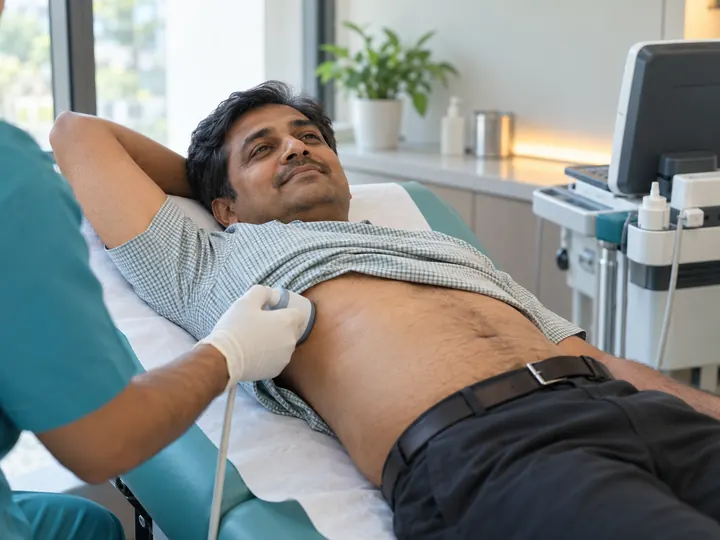
FibroScan is a special type of ultrasound. A probe placed on the skin over your liver sends a gentle pulse of vibration through the liver and measures how fast it travels. Stiffer, more scarred liver lets it travel faster. The same scan also estimates how much fat is in the liver. It gives two numbers, one for stiffness and one for fat, which Dr. Tumma reads together with your blood tests, ultrasound and history.
Why it is done
- Fatty liver found on an ultrasound or in blood tests
- Long-term hepatitis B or C, to check for scarring and decide on treatment
- Diabetes, obesity or high cholesterol, which raise the chance of liver damage
- Regular alcohol use, to see how the liver has been affected
- Following up liver scarring or cirrhosis over time and checking the response to treatment
Before: how to prepare
- Nothing to eat for 3 hours before the scan. A meal can make the reading falsely high.
- You can take your usual medicines with a little water.
- Wear a loose top or a two-piece outfit so the right side of your tummy is easy to reach.
- Bring previous liver blood tests, ultrasound reports and any earlier FibroScan results.
- Tell us beforehand if you have a pacemaker or another implanted electronic device, or if you are pregnant.
On the day
Lying down
You lie on your back with your right arm raised above your head, which opens up the spaces between the ribs.
Gel and probe
A little cool gel is applied to the right side of your chest and tummy, and the probe is placed between the ribs over the liver.
Readings
Several readings are taken. You feel a light tapping or flicking with each one, but no pain.
Your numbers
The machine shows the results at once, and the doctor explains what they mean for you.
After
- There is no recovery time; you can eat, drive and go back to work straight away.
- Wipe off the gel; it does not stain.
- Your numbers are one part of the picture. The doctor may suggest blood tests, an ultrasound or an endoscopy depending on the result.
- If you are being treated for a liver condition, ask when your next FibroScan should be.
Results. You get your results on the spot, with a stiffness score and a fat score. Dr. Tumma explains them in the context of your blood tests and history, and plans next steps with you.
Risks, explained honestly
Common and mild
- No real side effects; the gel may feel cold
- A light tapping feeling on the skin during the readings
Rare but serious
- No known serious risks. It uses sound waves and vibration, not X-rays or needles
- Readings can be less reliable after a recent meal, with obesity, with fluid in the tummy (ascites), or during a flare of hepatitis or heart failure; the test may then need repeating or another test may be advised
Where it is done
Available at Sun Care and at Kamineni Hospitals. Dr. Tejaswini will advise which suits you, for example when sedation or a hospital stay is needed.
Fees are shared when you book.
Questions patients ask
Used for
Other tests
- Upper GI endoscopy10 min
- Colonoscopy20–30 min
- ERCP30–60 min
- Endoscopic ultrasound20–45 min
- PolypectomyDuring colonoscopy
- Sigmoidoscopy10–15 min
- Variceal banding & glue15–30 min
Book a 15‑minute visit
At the clinic or online, Monday to Saturday. Pick a time and the front desk will confirm.
This page is general information reviewed by Dr. Tejaswini Tumma. It does not replace a consultation.